What Size Air Conditioner Do You Need for a Room?
The air conditioner size you need starts with room area. Match square footage to the model’s coverage, adjust for sun and other heat sources, and compare portable units by SACC or DOE capacity.
On this page (10 sections)
- What size air conditioner do I need by room area?
- How do you calculate the room size?
- What can change the BTU size you need?
- Does air conditioner type change how you size it?
- Which example units fit common room sizes?
- What happens if the air conditioner is too small or too large?
- What should you check before choosing a size?
- How do setup and care affect the cooling you get?
- Which sizing mistakes should you avoid?
- How do you choose the right air conditioner size?
The air conditioner size you need starts with your room’s square footage, then changes with sunlight, ceiling height and heat sources. Measure the area you want to cool, match it to a suitable capacity, and check that the unit can fit or vent through your window.
BTU describes cooling capacity, not the cabinet’s physical size. For an overview of installation options, see our guide to window, portable and through-the-wall air conditioners.
What size air conditioner do I need by room area?
Use floor area to narrow your choices, then adjust for the room’s conditions. The examples below show each model’s stated maximum coverage, not a universal sizing chart.
| Room area | Example capacity | Unit type |
|---|---|---|
| Up to 150 sq ft | GE: 5,000 BTU | Window |
| Up to 350 sq ft | LG: 8,000 BTU | Window |
| Up to 450 sq ft | Black+Decker: 10,000 BTU ASHRAE | Portable |
| Up to 700 sq ft | Black+Decker: 14,000 BTU ASHRAE, 10,200 BTU SACC | Portable |
Maximum coverage is a ceiling, not a promise for every room. A shaded bedroom and a sunny top-floor room can have the same floor area but place different demands on an AC.
Don't read the rows as steps that every buyer must follow. A room between these examples may suit another capacity, and you don't need to choose a much larger model just because it appears next in the table.
Portable ASHRAE figures also aren't direct equivalents to window-unit BTU figures. Compare capacity within the same format and use the brand’s room guidance to judge fit.
How do you calculate the room size?
Multiply length by width in feet to find square footage. A 14 x 20 ft room measures 280 sq ft.
Measure the usable room, including open alcoves that share its air. Don't subtract the area covered by a bed, desk or sofa.
For an L-shaped room, split the floor into rectangles and add their areas. For example, a 12 x 15 ft section plus an 8 x 10 ft section totals 260 sq ft.
If your tape gives inches, divide each dimension by 12 before multiplying. Rounding a measurement slightly is fine, but guessing room size from the amount of furniture can put you in the wrong capacity range.
Record ceiling height separately. Floor-area guidance generally assumes an ordinary residential ceiling, so a loft or vaulted room needs closer attention to volume and heat buildup.
What size air conditioner do I need for connected rooms?
Size for the connected area you intend to cool, but check whether air can reach all of it. An open living and dining room is different from 2 bedrooms joined by a hallway.
An AC near one end of a long space may cool its immediate surroundings before the far end feels comfortable. A larger compressor doesn't remove that airflow problem.
If you plan to close a bedroom door at night, size that bedroom as its own cooling space. Don't count on a living-room unit to keep it comfortable through a closed door.
What can change the BTU size you need?
Sun, room height, people and appliances can increase the cooling load. Use your area measurement as the baseline, then review the conditions that make your room warmer than a typical room.
- Strong sun: Large west-facing windows can add substantial afternoon heat.
- High ceilings: More room volume can make floor-area guidance less useful.
- Extra occupants: A home office used by one person has a different load from a busy gathering space.
- Cooking: An open kitchen adds heat while the oven or stove is running.
- Electronics: Several computers or other heat-producing devices can affect the choice.
- Insulation and air leaks: Hot air entering around windows and doors adds work for the AC.
Think about the room’s hardest regular conditions, not one unusual afternoon. If you work there every day during peak sun, that heat matters more than an occasional extra guest.
Close blinds against direct sun and seal obvious installation gaps before assuming you need much more capacity. These steps reduce incoming heat, though they won't make an undersized unit suitable for a much larger space.
Avoid stacking guessed BTU allowances for every factor. If several demanding conditions overlap, use the manufacturer’s sizing guidance or get a room cooling assessment before choosing.
Does air conditioner type change how you size it?
Yes, compare capacity using the right method for the unit type. Portable ACs can show both ASHRAE and SACC or DOE figures, while window models use their own capacity and coverage guidance.
SACC accounts for effects that reduce a portable AC’s useful cooling, including heat associated with its exhaust setup. That makes it more helpful than the larger ASHRAE number when comparing portable choices.
An exhaust hose carries heat outdoors, but its placement and window seal still matter. Poor setup can let warm air back in and reduce the cooling you feel.
Our guide to choosing a portable air conditioner by BTU, SACC and hose type explains the numbers in more detail. For installation and space trade-offs, compare portable and window air conditioners.
Choose the format before comparing headline numbers. If your lease or window prevents a window-mounted unit, focus on portable models with suitable effective capacity and a workable exhaust route.
Which example units fit common room sizes?
Choose the smallest suitable capacity for the room’s actual load, with controls and installation requirements that fit your routine. These 4 examples serve different spaces and should not be treated as interchangeable.
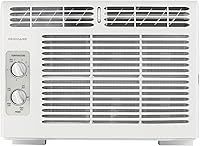
GE for small bedrooms and simple controls
Choose the GE for a compact bedroom, dorm room or home office where you want straightforward operation. Its mechanical dials suit buyers who prefer adjusting the unit directly instead of using an app.
The controls include 10 temperature settings, 2 cooling modes and 2 fan speeds. The dial settings aren't a digital temperature readout, so expect to find a comfortable position rather than select an exact displayed room temperature.
Installation fit is especially important here: it needs a double-hung window 27.125–36 inches wide with a minimum opening height of 13.375 inches. Its compact cabinet doesn't mean it fits every narrow window.
Skip it for a larger living room or a small room with unusually heavy heat gain. Also choose another option if a remote is essential, since its appeal is simple control at the unit.
LG for medium rooms and remote adjustments
Choose the LG for a medium bedroom or living room where remote control and airflow adjustment matter. It offers 3 cooling and fan speeds, Auto Cool and 4-way air deflection.
The 24-hour timer lets you plan operation around room use. Aim airflow into the room rather than directly at nearby curtains or furniture so the cool air has a clear path.
A 14 x 25 ft room reaches its stated coverage limit, leaving less room for demanding conditions. Strong afternoon sun or an open kitchen deserves a closer sizing check before you settle on it.
Skip it for a tiny enclosed room simply because it has more features than the GE. Also confirm the required window opening in the installation instructions, since cabinet dimensions alone don't guarantee fit.
Black+Decker portable for flexible room use
Choose the smaller Black+Decker portable if you need a floor-standing unit and can vent it through a suitable window. Casters and side handles help with moves between rooms on the same level.
Its 10,000 BTU ASHRAE figure is paired with DOE figures of 5,550, 5,750 or 6,300 BTU across production batches. Use the DOE figure on the exact unit when comparing it with another portable model.
The Follow Me remote can act as a thermostat near your seating area. Keep it away from direct sun and the cold outlet airflow so its location reflects the comfort you want.
Skip it if you expect to roll it anywhere without setup: every cooling location needs an exhaust connection. It also weighs 48.6 lb, so stairs and frequent lifting deserve more thought than the wheels suggest.
Black+Decker smart portable for larger open rooms
Choose the larger Black+Decker portable for a spacious open room where you need greater effective capacity and want app control. Its 10,200 BTU SACC figure is the useful comparison point against other portable models.
Wi-Fi control works through the Black+Decker app, with Amazon Alexa and Google Assistant support. The remote also offers Follow Me control, so app use isn't your only way to adjust comfort.
Its timer and Sleep Mode suit buyers who want cooling to follow a daily routine. Still, smart controls don't solve poor air distribution across walls or around corners.
Skip it for a small closed bedroom where that much capacity is unnecessary. Its stated coverage also shouldn't be read as a promise to cool several separate rooms evenly.
What happens if the air conditioner is too small or too large?
An undersized AC can run for long periods without reaching the set temperature, while an oversized one can cool quickly and leave the room feeling damp. Matching the load matters more than buying the largest number.
An AC removes moisture while it cools. If an oversized unit repeatedly shuts off after short cooling runs, it may have less time to manage humidity.
Long operation alone doesn't prove the unit is too small. Very hot weather, a warm room at startup or heat entering through an open door can keep a correctly sized AC working.
Look for a pattern after checking setup and care. A room that stays warm despite clear airflow, a clean filter and closed windows may need a different capacity or a closer look at heat gain.
Don't lower the thermostat to its minimum as a sizing fix. That changes the target temperature, not the unit’s maximum cooling capacity.
What should you check before choosing a size?
Confirm window fit, exhaust access and electrical requirements before ordering. The right capacity is useful only if you can install and operate the unit correctly.
For a window AC, measure the actual opening rather than the glass. Check window type, mounting requirements and any building or lease restrictions.
Read our guide to how to install a window air conditioner and check whether your window AC needs a support bracket. Use the support and weather-sealing method required for the unit and your building.
For a portable AC, mark out space near the exhaust window. Allow the required clearances around air intakes and leave room to remove the filter and reach the drain.
Route the exhaust hose as directed, with a short, direct path and no tight bends. Don't extend it with an improvised hose or vent it into another room.
Check the appliance label and manual for outlet and circuit needs. Plug it into a suitable wall outlet, and follow the manufacturer’s instructions about cords, adapters and shared circuits.
How do setup and care affect the cooling you get?
Clear airflow, a sealed installation and a clean filter help preserve cooling performance. Check these before replacing an AC that seems unable to handle the room.
Keep curtains, furniture and storage away from the intake and outlet. A cold pocket around the unit can leave the rest of the room warm and affect temperature control.
Keep windows and exterior doors closed during cooling. Use blinds or curtains to limit direct sun without blocking the AC itself.
Inspect washable filters on the schedule in the manual, with more frequent checks in dusty rooms. Let a washed filter dry as directed before reinstalling it, and use our window air conditioner cleaning guide for the wider care routine.
Follow the portable unit’s drainage instructions for the mode and conditions in use. Dehumidifier operation can have different drainage needs from normal cooling, so plan access to the drain before placing the unit.
If cooling drops, check the selected mode, filter, airflow and exhaust connection first. Ice, repeated shutoffs or a persistent fault needs attention rather than a larger replacement chosen on guesswork.
Which sizing mistakes should you avoid?
Don't confuse room coverage with whole-home cooling or mix unlike capacity figures. Those mistakes can lead to a poor choice even when the arithmetic is correct.
- Buying extra capacity for faster cooling: Excess capacity can leave a small room cool but damp.
- Using only the largest portable number: Compare SACC or DOE capacity alongside room guidance.
- Ignoring the open kitchen: Cooking heat belongs in the sizing decision.
- Measuring only the main rectangle: Open alcoves and connected living areas add floor area.
- Assuming wheels remove installation work: A portable still needs an outdoor exhaust route.
- Blaming capacity for blocked airflow: Curtains, dirty filters and poor venting can limit cooling.
Capacity also isn't the same as electricity use. For a closer look at power, runtime and utility rates, see how much it costs to run a window air conditioner.
How do you choose the right air conditioner size?
To decide what size air conditioner you need, measure the space, identify its heat load and choose a format you can install correctly. Then compare suitable models using the same capacity method.
Choose the GE for a small enclosed room and simple dial controls. Move to the LG when a medium room needs more coverage and you want remote adjustments.
Choose the smaller Black+Decker when a portable format fits your window and room better. Consider the larger smart model for a larger open space, using effective capacity rather than its headline number to guide you.
If your room falls between these examples, keep shopping within the right capacity range instead of forcing a match. Strong sun, high ceilings and difficult layouts are reasons to check sizing more closely before ordering.
Write down your room dimensions, ceiling height, window measurements and main heat sources before comparing units. If installation format is still the deciding factor, use our air conditioner type guide to choose your next step.
Frequently asked questions
How many BTUs do I need for a 12 x 12 room?
A 12 x 12 ft room has 144 sq ft of floor area, making a 5,000 BTU window unit a starting point for ordinary conditions. Strong sun, high ceilings or extra heat from appliances can change the choice, so check the brand’s sizing guidance before buying.
Is a higher BTU air conditioner always better?
No, higher BTU capacity is useful only when the room needs it. An oversized unit can cool the air quickly and shut off before removing enough moisture, while an undersized unit may run for long periods without reaching the set temperature.
Do portable air conditioners need more BTUs than window units?
Portable air conditioners often show a larger ASHRAE number, but that number is not a direct match for window-unit capacity. Use SACC or DOE figures to compare portable models, then consider room coverage, exhaust setup and how much heat enters your space.
How do I calculate the area of an irregular room?
Divide an irregular room into rectangles, multiply each length by its width, and add the results. Include an open alcove where air can circulate freely, but remember that a narrow doorway or hallway can prevent one air conditioner from cooling connected spaces evenly.
Should I size an air conditioner for the whole home?
Size a room air conditioner for the room or open area it will serve, rather than the entire home. Closed bedrooms and rooms around corners may need separate cooling because enough total capacity does not ensure that cool air can reach every space.