Can You Put an Air Conditioner in a Casement Window?
A window air conditioner for casement windows must be designed for your opening and mounting method. A portable AC with a sealed exhaust opening is another option when a window unit won't fit.
On this page (9 sections)
- Can you put a window air conditioner in a casement window?
- Which window air conditioner for casement windows makes sense?
- Which portable AC seal should you choose?
- Does the Black+Decker portable AC suit this setup?
- What should you measure before ordering?
- How should you set up the AC and seal?
- Which setup mistakes should you avoid?
- How do you keep the setup working through summer?
- Which casement-window cooling setup should you buy?
A window air conditioner for casement windows must match the hinged opening and its mounting requirements. Most standard window ACs need a vertically sliding sash, so a casement-specific unit or a portable AC with a sealed exhaust opening is the practical choice.
Start with how the window opens, then measure it. A window that swings outward needs a different approach from a sliding window AC installation.
The 2 seals below help vent a portable AC. The Black+Decker is the cooling appliance; none of these products is a window-mounted casement AC.
Can you put a window air conditioner in a casement window?
You can install one when the AC's installation guide allows your window type and the opening meets its requirements. Physical fit alone isn't enough.
Standard window units usually rely on a sash closing onto the cabinet, plus side panels and specified mounting hardware. A hinged window doesn't provide that same arrangement.
A casement-specific model may solve the shape problem, but you still need the required clear width, height, mounting surfaces, and support. Check whether the open sash, crank handle, or hinges would interfere with the cabinet.
Don't turn a standard window AC sideways to make it fit. Use only the orientation and mounting method allowed by its manufacturer.
Which window air conditioner for casement windows makes sense?
Choose a casement-specific unit for a compatible fixed installation, or a portable AC when a sealed hose opening is more practical. Renters should also check their lease before attaching hardware or adhesive tape.
| Option | Choose it when | Skip it when |
|---|---|---|
| Casement-specific window AC | The opening and mounting surfaces meet its manual | The frame cannot provide the required support |
| Portable AC with fabric seal | You need a seasonal setup and have a suitable frame | The tape cannot attach securely or the hose cannot reach |
| Portable AC with fitted hose panel | You want a rigid closure around the hose | You cannot secure the panel without altering the window |
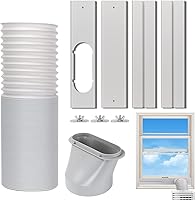
A custom hose panel fills the opening around a portable AC vent. It doesn't support a window AC, and its attachment must suit the frame.
For a broader comparison, see window, portable, and through-the-wall air conditioners. Use our air conditioner sizing guide to check capacity before choosing a model.
Which portable AC seal should you choose?
Choose a seal by window shape, perimeter, and attachment surface. Both options here use fabric and adhesive hook tape, so neither is a rigid security barrier or structural mount.
Portable air conditioner seals for casement windows: IKSTAR
The IKSTAR kit suits seasonal use on smooth casement or crank-out frames, especially if you need a zipper opening for single or dual hoses. It also covers push-out and skylight windows.
Its maximum window perimeter is 157 in, and installation requires no drilling. Measure the full attachment path rather than just the window's width or open gap.
Pick this seal when hose placement needs some flexibility. Skip it if your perimeter exceeds the limit or the frame is rough, dirty, or otherwise unsuitable for adhesive attachment.
Clean and dry the frame before applying the tape. Check the corners for gaps after positioning the hose, since a closed zipper won't help if the fabric has pulled away elsewhere.
When does the HOOMEE fabric seal make sense?
The HOOMEE seal suits left-opening, right-opening, bottom-hung, and skylight windows where its fabric can attach without catching in the frame. Its instructions also cover outward-opening casement windows.
This polyester seal also fits a maximum perimeter of 157 in. Choose between these 2 kits based on your window's attachment path and hose arrangement, rather than expecting extra cooling from either brand alone.
HOOMEE's instructions distinguish the wider frame side from the narrower casement side. Lay out the fabric before sticking down the tape so those edges land in the right places.
Skip this option if the corners or hinge area prevent a continuous seal. Spot clean the fabric, and don't force the sash closed over trapped material.
Does the Black+Decker portable AC suit this setup?
The Black+Decker suits buyers who need an AC as well as a window vent solution, provided its capacity fits the room. A seal kit alone cannot cool anything.
Its 9,000 BTU capacity uses the ASHRAE measure; its portable AC SACC capacity is 5,300 BTU. Compare SACC with SACC when shopping across portable models, rather than treating the larger number as equivalent.
Black+Decker describes coverage up to 400 sq ft, but room conditions still matter. Strong sun, high ceilings, and an open doorway to another room can change the cooling load.
The unit includes an exhaust hose and adapters, plus cooling, dehumidifier, and fan modes. Its Follow Me remote acts as a thermostat, which suits people who want temperature control near their seating or sleeping area.
Skip it if the room needs more capacity or lacks a clear floor position near the window. The cabinet measures 14 in deep by 15.3 in wide by 24.8 in high, with additional space needed for airflow and the hose.
Casters help with moving it, but each room still needs a vent setup. Use our guide to choosing a portable AC by capacity and hose type before settling on a unit.
What should you measure before ordering?
Measure the clear opening, frame perimeter, room, and hose route. Each answers a different buying question.
For a window-mounted AC, record the usable width and height with the sash open as required. Compare them with the installation dimensions, not just the cabinet dimensions.
For a fabric seal, follow the intended tape path around the frame and moving sash. Check that hinges, handles, screens, and locks won't prevent attachment or hose access.
For a portable AC, plan a stable floor position within the permitted hose reach. Avoid a route across a doorway or behind furniture that could crush the hose.
Measure the room's floor area, then account for its conditions using what size air conditioner you need. Buying a larger unit won't fix an unsuitable window connection.
How should you set up the AC and seal?
Install the vent arrangement so hot air reaches outdoors without leaking back through the opening. Follow both the AC manual and the seal instructions.
- Check frame condition and confirm the attachment path.
- Clean and dry the tape surfaces.
- Lay out the seal before attaching its edges.
- Connect the exhaust hose and adapters as directed.
- Pass the hose through the zipper and close it snugly around the connection.
- Check corners, hose clearance, and the window's allowed movement.
Keep the exhaust outlet clear outdoors. Indoors, leave the required space around the intake and outlet, and connect power as the manual directs.
Don't assume the Black+Decker's included window components fit a hinged opening. You may need a compatible fabric seal or fitted panel for that connection.
For a window-mounted model, start with how to install a window air conditioner and use your model's mounting instructions. Fabric-seal installation steps don't apply to supporting a heavy window unit.
Which setup mistakes should you avoid?
Avoid unsupported cabinets, leaking gaps, and strained exhaust hoses. These problems call for a better installation, not a lower thermostat setting.
Don't extend a portable AC hose or replace it with another type unless the manufacturer allows it. Keep bends gentle and use the intended hose length.
Don't confuse a fabric seal with insulation or weatherproof construction. Check its edges after opening the window, moving the AC, or reconnecting the hose.
Keep any required emergency exit usable. If the frame is damaged or you can't secure the equipment, choose another location or get advice from a qualified installer.
If the sash moves sideways, read how to use an AC with a sliding window. If it moves up and down, see air conditioners for vertical windows.
How do you keep the setup working through summer?
Keep filters, air paths, and seal edges clean and clear. A secure first installation still needs routine checks.
The Black+Decker has a washable filter; follow its manual for removal, cleaning, and drying. Check the drainage instructions for the operating mode and room conditions.
Inspect adhesive edges for lifting and check that the hose connections remain secure. For HOOMEE fabric, use spot cleaning rather than assuming machine washing is suitable.
At season's end, disconnect and store the AC as directed. Remove any hose before closing the window, and make sure fabric isn't trapped in the sash.
Which casement-window cooling setup should you buy?
Choose a window air conditioner for casement windows when a purpose-built model fits the opening and approved mounting method. Choose a portable AC when you can spare floor space and create a short, sealed exhaust route.
Pick IKSTAR for its flexible single or dual hose opening. Pick HOOMEE when its frame-and-casement attachment layout suits your window, and choose the Black+Decker only after confirming capacity and placement.
If neither approach fits, resolve the window connection before ordering an AC. Use the air conditioner sizing guide to narrow your capacity needs once you know which setup will work.
Frequently asked questions
Can a regular window air conditioner fit a casement window?
Usually, no. Most regular window ACs need a vertically sliding sash, while a casement window swings on hinges.
A cabinet that fits through the opening still needs approved mounting surfaces, support, and gap panels.
Choose a model whose installation guide allows your window type.
What kind of air conditioner works in a casement window?
A casement-specific window AC or a properly vented portable AC can work.
Choose the window unit when its opening and mounting requirements fit your frame. Choose a portable unit when you have floor space, a short hose route, and a suitable way to seal the open window.
Can you use a portable air conditioner with a casement window?
Yes, a portable AC can vent through a casement window using a compatible fabric seal or fitted hose panel. Measure the frame perimeter and check the hose arrangement before ordering.
The seal closes the surrounding gap; it does not cool the room or replace the AC's exhaust hose.
Do you need a support bracket for an air conditioner in a casement window?
A window-mounted AC needs the support required by its installation manual, which may include a bracket or other hardware.
A portable AC stays on the floor, so the window holds only its vent arrangement. Neither fabric seals nor portable AC hose panels can support a window unit.