10 Best Portable Air Conditioners (November 2026)
The best portable air conditioners include the Black+Decker 10 for everyday room cooling, the Black+Decker 14 for connected living rooms, and the Black+Decker 12 for connected home offices.
On this page (9 sections)
- How we chose these portable air conditioners
- Portable air conditioner comparison
- The best portable air conditioners for different rooms
- How do you choose the best portable air conditioner capacity?
- What should you measure before ordering?
- How do you set up a portable AC for better cooling?
- How do you care for a portable air conditioner?
- Which portable AC mistakes should you avoid?
- Which portable air conditioner should you choose?
The best portable air conditioner for everyday room cooling in this group is the Black+Decker 10,000 BTU model, thanks to its Follow Me remote and included window kit. Choose a different model when higher capacity, app scheduling or a dual-hose design better matches your room.
Start with the room and window, then choose the controls. A portable AC needs floor space near an outdoor exhaust route, so the largest cooling number won't solve a poor installation.
Our portable air conditioner buying guide explains capacity and hose choices. For a sleeping space, the guide to portable air conditioners for bedrooms focuses on placement and nighttime needs.
Our picks at a glance
-
1
 Best for everyday room cooling
Black+Decker 10,000 BTU portable air conditioner
9.2/10 our score
See it on Amazon -
2
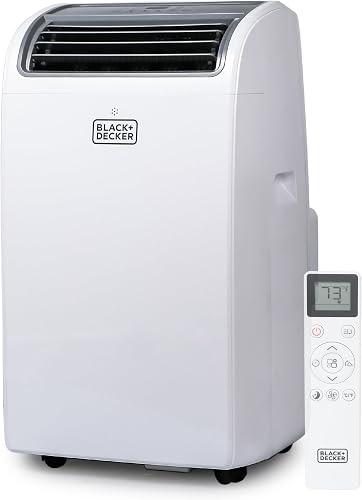 Best for connected living rooms
Black+Decker 14,000 BTU smart portable air conditioner
9.0/10 our score
See it on Amazon -
3
Best for connected home offices
Black+Decker 12,000 BTU smart portable air conditioner
8.7/10 our score
See it on Amazon
- 4
 Check it
Black+Decker 9,000 BTU portable air conditioner
Best for smaller spare rooms - 5
 Check it
Midea 10,000 BTU portable air conditioner
Best for scheduled room cooling - 6
 Check it
Garvee 14,000 BTU 3-in-1 portable air conditioner
Best for stationary larger rooms - 7
 Check it
Whynter 14,000 BTU dual hose portable air conditioner
Best for draft-prone rooms - 8
 Check it
Black+Decker 8,500 BTU portable air conditioner
Best for tight floor plans - 9
 Check it
SereneLife 8,000 BTU 3-in-1 portable air conditioner
Best for occasional daytime cooling - 10
 Check it
SereneLife 8,000 BTU dual motor portable air conditioner
Best for remote-first small rooms
How we chose these portable air conditioners
We compared cooling capacity, room fit, controls and installation needs to match each unit to a useful role. The order favors practical room cooling, while the badges highlight reasons to choose a lower-ranked option.
Coverage claims come from the brands and aren't promises for every room. Strong afternoon sun, open doorways and high ceilings can make a space harder to cool than its floor area suggests.
Portable air conditioner comparison
Use SACC capacity and physical fit to narrow the choices, then compare controls. Brand coverage claims help with screening, but they aren't a consistent way to rank cooling strength across brands.
| Product | Best for | Cooling | Room size | Controls | Our score |
|---|---|---|---|---|---|
| Black+Decker 10,000 BTU portable air conditioner | everyday room cooling | 10,000 BTU ASHRAE | Black+Decker claims up to 450 sq. ft. | Remote with Follow Me function | 9.2 |
| Black+Decker 14,000 BTU smart portable air conditioner | connected living rooms | 14,000 BTU ASHRAE, 10,200 BTU SACC | Black+Decker claims up to 700 sq. ft. | App, voice and remote | 9.0 |
| Black+Decker 12,000 BTU smart portable air conditioner | connected home offices | 12,000 BTU ASHRAE | Confirm exact-version coverage with Black+Decker | App, voice and remote | 8.7 |
| Black+Decker 9,000 BTU portable air conditioner | smaller spare rooms | 9,000 BTU ASHRAE, 5,300 BTU SACC | Black+Decker claims up to 400 sq. ft. | Remote with Follow Me function | 8.5 |
| Midea 10,000 BTU portable air conditioner | scheduled room cooling | 10,000 BTU ASHRAE, 7,100 BTU SACC | Midea claims up to 300 sq. ft. | App, voice and remote | 7.7 |
| Garvee 14,000 BTU 3-in-1 portable air conditioner | stationary larger rooms | 14,000 BTU, 9,300 BTU SACC | Garvee claims up to 750 sq. ft. | LED panel and remote | 7.5 |
| Whynter 14,000 BTU dual hose portable air conditioner | draft-prone rooms | 14,000 BTU, 10,000 BTU SACC | Whynter claims up to 500 sq. ft. | 7.3 | |
| Black+Decker 8,500 BTU portable air conditioner | tight floor plans | 8,500 BTU ASHRAE, 5,100 BTU SACC | Black+Decker claims up to 350 sq. ft. | 7.3 | |
| SereneLife 8,000 BTU 3-in-1 portable air conditioner | occasional daytime cooling | 8,000 BTU | Confirm coverage with SereneLife | Digital panel and remote | 7.1 |
| SereneLife 8,000 BTU dual motor portable air conditioner | remote-first small rooms | 8,000 BTU | Confirm coverage with SereneLife | Digital panel and remote | 6.7 |
The best portable air conditioners for different rooms
The Black+Decker 10,000 BTU is the straightforward starting choice here. Move to another pick when your room needs more cooling, less cabinet space or a different venting arrangement.
Best portable air conditioner for everyday use: Black+Decker 10,000 BTU
Black+Decker 10,000 BTU portable air conditioner: Best for everyday room cooling
- 10,000 BTU ASHRAE
- Follow Me remote
- Washable filter
- Window kit included
A straightforward choice for cooling one room with temperature sensing at the remote. Casters and side handles help with moves on the same floor.
Pros
- Follow Me temperature sensing
- Washable slide-out filter
- Window kit included
Cons
- Lower DOE capacity than the headline BTU figure
- Needs floor space near a suitable window
Choose this model for one regularly used room where you want simple controls and temperature sensing near your seat. Follow Me lets the remote act as the thermostat, rather than relying only on conditions beside the cabinet.
Place that remote near the occupied part of the room, away from direct sunlight and the cold air outlet. A sensor beside a hot computer or in the cold airflow can give a poor picture of your comfort.
The cabinet measures 15.3 W x 14 D x 24.8 H in before hose space and operating clearance. Casters help across a clear floor, but each room still needs its own workable exhaust setup.
Skip it if your priority is app access or cooling a demanding larger room. Its headline capacity is paired with a lower DOE figure, so don't compare the headline alone against SACC numbers.
For a room used mainly at night, compare its fit with the options in our portable bedroom AC guide.
Black+Decker 14,000 BTU smart portable air conditioner
Black+Decker 14,000 BTU smart portable air conditioner: Best for connected living rooms
- 14,000 BTU ASHRAE, 10,200 BTU SACC
- Wi-Fi app control
- Alexa and Google Assistant compatibility
- Follow Me remote
The higher-capacity connected Black+Decker suits a larger room where remote access matters. A timer and Sleep Mode add ways to manage daily use.
Pros
- App and voice control
- Follow Me remote
- 24-hour timer and Sleep Mode
Cons
- Larger cabinet than the top pick
- Less convenient for frequent carrying
Choose this model for a larger living room with connected controls. Black+Decker claims coverage up to 700 sq. ft., and app access plus Alexa and Google Assistant support give you several ways to change settings.
Its 10,200 BTU SACC capacity is the highest stated SACC figure among these picks. That makes it a stronger capacity candidate than models with similar headline numbers but lower SACC figures.
The timer suits a predictable routine, while Sleep Mode changes the temperature overnight. Use those functions to match occupied hours rather than leaving a room at an unnecessarily low setting all day.
Skip it for a small room chosen only because more capacity sounds better. A larger cabinet also needs a clear parking spot, and frequent carrying between floors is a poor use of a portable unit.
If your room needs less capacity but you still want connected controls, consider the next Black+Decker.
Black+Decker 12,000 BTU smart portable air conditioner
Black+Decker 12,000 BTU smart portable air conditioner: Best for connected home offices
- 12,000 BTU ASHRAE
- Wi-Fi app and voice control
- Follow Me remote
- Window kit included
A middle-capacity smart option for a room that needs app access and local remote control. Confirm the exact version's capacity and dimensions before ordering.
Pros
- App control
- Alexa and Google Assistant compatibility
- Follow Me remote
Cons
- SACC and coverage figures differ across descriptions
- Cabinet dimensions need confirmation for tight spaces
This is the middle-capacity smart choice for a home office or similar enclosed room. App and voice access let you adjust cooling without going to the cabinet, while Follow Me gives you local temperature sensing.
It makes sense when you want connected features without automatically choosing the largest model. A closed office also gives a room AC a clearer cooling task than an open hallway shared with several rooms.
Black+Decker's descriptions differ on this model's SACC capacity, coverage and cabinet dimensions. Confirm the exact version's figures with Black+Decker before choosing it for a tight opening or a room near its capacity limit.
Skip it if you need a firm capacity comparison immediately and can't resolve those differences. The larger smart option has a clearer stated SACC figure for comparing cooling needs.
Use our room air conditioner sizing guide to account for floor area and room conditions before deciding between them.
Black+Decker 9,000 BTU portable air conditioner
Black+Decker 9,000 BTU portable air conditioner: Best for smaller spare rooms
- 9,000 BTU ASHRAE, 5,300 BTU SACC
- Follow Me remote
- Self-evaporating operation
- Washable filter
A lower-capacity option with temperature sensing at the remote and a timer for planned use. Its cabinet occupies the same space as the top pick.
Pros
- Follow Me remote
- 24-hour timer
- Washable filter
Cons
- No cabinet-space savings over the top pick
- Less cooling capacity than larger models
Choose this model for a smaller spare room with planned use, such as a guest room or occasional workspace. Its Follow Me remote and timer are useful when you want comfort around a particular chair or at set hours.
Black+Decker claims coverage up to 400 sq. ft., but the 5,300 BTU SACC figure is the better basis for capacity comparisons. Don't treat the coverage claim as a reason to ignore strong sun or an open layout.
This unit occupies the same cabinet space as the top pick. Choose it because its capacity fits the room, not because you expect the smaller cooling number to mean a smaller appliance.
Self-evaporating operation can reduce routine water handling, but follow the manual's drainage steps for humid conditions and storage. Keep drain access reachable after positioning the unit.
Skip it for a heat-heavy larger room, and consult our quiet portable air conditioner guide before making it a bedside choice.
Midea 10,000 BTU portable air conditioner
Midea 10,000 BTU portable air conditioner: Best for scheduled room cooling
- 10,000 BTU ASHRAE, 7,100 BTU SACC
- SmartHome app scheduling
- Alexa and Google Assistant compatibility
- Adjustable 24-hour timer
A smart-control choice for a smaller room with a regular cooling schedule. Measure the window carefully against its bracket range.
Pros
- App scheduling
- Remote included
- Reusable filter
Cons
- Coverage claim limited to smaller rooms
- Window bracket range may exclude narrow openings
Midea suits a smaller room with a regular daily schedule. The SmartHome app can schedule operation and change modes, while a remote and onboard display keep everyday control available without voice commands.
Midea claims coverage up to 300 sq. ft. Its capacity pairing also shows why equal headline BTU numbers don't necessarily mean equal portable cooling capacity.
The window brackets fit openings from 26.5 to 48 in, and the included exhaust hose is 5 ft long. Measure both the opening and the route before assuming the kit will work beside your desk or bed.
Midea recommends cleaning the reusable filter every week of operation. That routine matters in a room where pet hair or dust collects near the intake.
Skip this model if the window falls outside its bracket range or you need broader room coverage. Our portable AC sizing and setup guide helps separate capacity needs from convenience features.
Garvee 14,000 BTU 3-in-1 portable air conditioner
Garvee 14,000 BTU 3-in-1 portable air conditioner: Best for stationary larger rooms
- 14,000 BTU, 9,300 BTU SACC
- 24-hour timer
- Sleep Mode
- Window kit included
An option for a larger room where the cabinet can stay near one window. Its weight makes frequent moves less appealing.
Pros
- Remote and timer
- Cooling, fan and dehumidifier modes
- No-drill window kit
Cons
- 85.3 lb cabinet
- Large footprint needs planning
Garvee is worth considering for a larger room where the unit will stay put. Its remote, timer and Sleep Mode cover routine control without making connected features the reason to buy.
Garvee claims coverage up to 750 sq. ft., the broadest claim here. Its 9,300 BTU SACC is lower than the larger smart Black+Decker's figure, so the bigger coverage claim doesn't mean greater cooling capacity.
The cabinet weighs 85.3 lb and occupies a 20.16 x 18.11 in footprint. Plan delivery access, the final position and drain access before deciding that wheels will make frequent moves convenient.
The included no-drill kit is intended for double-hung or sliding windows. Check building rules as well as fit if you're using it in a rental.
Skip it for regular stair trips or a narrow room where the cabinet blocks circulation. Our air conditioner guide for apartments covers choices for different layouts.
Whynter 14,000 BTU dual hose portable air conditioner
Whynter 14,000 BTU dual hose portable air conditioner: Best for draft-prone rooms
- 14,000 BTU, 10,000 BTU SACC
- Dual-hose design
- Auto drain function
- Activated carbon filter
The dual-hose design helps limit the negative pressure associated with single-hose cooling. Allow space for both hoses and keep drainage access clear.
Pros
- Separate intake and exhaust hoses
- Auto drain function
- Upper gravity drain port
Cons
- Two hoses need window space
- Moisture handling depends on conditions
Choose Whynter when limiting warm replacement air matters more than keeping the hose arrangement simple. Its dual-hose design separates condenser intake and exhaust, reducing the negative-pressure drawback of single-hose cooling.
Whynter claims coverage up to 500 sq. ft. The 10,000 BTU SACC figure makes it a useful comparison with the larger connected Black+Decker, even though their coverage claims differ.
Whynter says its auto drain function exhausts condensate in most environments. An upper gravity drain port also supports continuous drainage when the setup and operating mode call for it.
The activated carbon filter adds odor filtration, but choose this AC for cooling and venting rather than expecting it to replace a dedicated air cleaner. Filter care remains part of regular maintenance.
Skip it if both hoses would crowd the window or block a walkway. Our one-hose vs. dual-hose guide explains what the second hose changes.
Black+Decker 8,500 BTU portable air conditioner
Black+Decker 8,500 BTU portable air conditioner: Best for tight floor plans
- 8,500 BTU ASHRAE, 5,100 BTU SACC
- Narrow cabinet
- Full-function remote
- Window kit included
A narrow cabinet suits a small room with limited space beside the window. The remote handles every function.
Pros
- Small cabinet footprint
- Washable filter
- 24-hour timer
Cons
- Lower cooling capacity than larger picks
- Remote batteries not included
Choose this Black+Decker when floor space beside the window is tight. Its 11.4 W x 11.02 D x 26.47 H in cabinet is narrower than the other Black+Decker cabinets described here.
That footprint can help beside furniture, but leave the manual's required clearance around the intake and outlet. A narrow unit squeezed between a dresser and curtain still needs room to move air.
Black+Decker claims coverage up to 350 sq. ft. Its lower SACC capacity makes room conditions especially important, so avoid choosing it for a sunny larger room just because the cabinet fits.
The window panels fit openings from 20.5 to 39 in, and the full-function remote needs 2 AAA batteries that aren't included. Check the window before treating this as the easiest compact option.
Skip it when capacity is the main challenge. If floor space is scarce, our portable vs. window AC comparison may point you toward a better installation style.
SereneLife 8,000 BTU 3-in-1 portable air conditioner
SereneLife 8,000 BTU 3-in-1 portable air conditioner: Best for occasional daytime cooling
- 8,000 BTU
- Three operating modes
- Three fan speeds
- Remote and window kit included
A basic option for a small room used mainly during the day. Resolve the conflicting coverage figures before sizing it for your space.
Pros
- Cooling, fan and dehumidifier modes
- Rolling wheels
- Remote sleep setting
Cons
- Conflicting coverage figures
- 55 to 57 dBA operating noise
This SereneLife is a candidate for occasional daytime use in a small room. Three fan speeds, a digital panel and remote controls cover basic cooling needs without making app features part of the choice.
Its cabinet measures 15.28 W x 14.02 D x 24.8 H in and comes with an exhaust hose, window installation plate and drain pipe. Check access for the hose and drain before choosing a corner.
SereneLife gives conflicting coverage figures of 215-plus and 350 sq. ft. Confirm the appropriate room size with SereneLife rather than planning around the larger number.
The stated operating noise range is 55 to 57 dBA. Skip it if low nighttime noise is your first concern, and don't assume the remote's sleep setting makes the compressor quiet.
Its strongest role is basic cooling after capacity and window fit are settled. Our portable AC sizing guide helps estimate the room's needs.
SereneLife 8,000 BTU dual motor portable air conditioner
SereneLife 8,000 BTU dual motor portable air conditioner: Best for remote-first small rooms
- 8,000 BTU
- Digital control panel
- Remote with sleep setting
- Window exhaust kit
A basic small-room candidate for buyers who prefer adjusting settings from their chair. Its dual motors do not make it a dual-hose unit.
Pros
- Remote adjusts sleep and temperature units
- Three fan speeds
- Window exhaust kit
Cons
- Coverage needs confirmation
- 55 to 57 dBA operating noise
Consider this SereneLife for a small room where remote control is the main convenience. The remote handles the sleep setting and temperature units, while the digital panel covers power, mode, timer and fan settings.
Its cabinet measures 12.8 W x 11.6 D x 27.2 H in, giving it a different shape from the other SereneLife above. Measure the available width and height rather than choosing from photos.
Coverage needs confirmation with SereneLife before you size it for the room. Its stated noise range also makes it a weaker fit for someone whose first priority is quiet sleep.
A dual-motor design is not a dual-hose design. Motors describe internal machinery; hoses determine how air reaches the condenser and leaves the room.
Skip it if you're buying specifically to reduce single-hose pressure effects. Compare the Whynter dual-hose portable AC for that venting arrangement.
How do you choose the best portable air conditioner capacity?
Choose capacity for the enclosed room you'll actually cool, then allow for heat sources and sun. Measure length times width for floor area, and include connected spaces only if you expect the unit to cool them too.
Compare SACC before headline BTU
SACC is the more useful comparison when both models provide it. It accounts for portable-unit effects, including hose heat and replacement air, while ASHRAE uses different conditions.
Don't subtract one model's ASHRAE number from another model's SACC number. Use the same measure, then consider room layout and window fit.
Account for the room's heat load
Direct sun, tall ceilings and hot appliances can increase cooling needs. A shaded bedroom and a sun-facing room of equal floor area may need different choices.
Too little capacity can mean long operation without reaching your target temperature. Too much can cause short cycles and leave humidity control less effective, so bigger isn't automatically better.
Decide how many rooms matter
One portable unit works best on one defined cooling area. Air doesn't travel around corners and through doorways as easily as a broad coverage claim might suggest.
For a bedroom and distant office, plan separate cooling periods and suitable exhaust setups. Don't expect a unit parked in a hallway to control both evenly.
What should you measure before ordering?
Measure the window opening, cabinet position and hose route before you buy. All 3 must work together for a usable installation.
Check the window's opening direction as well as its size. A panel designed for a double-hung or sliding window doesn't automatically fit a window that swings outward.
Allow room for curtains, furniture and the window latch. Keep the hose route short and direct within the manual's limits, without stretching it across a walkway.
Check that the power cord reaches an appropriate grounded outlet. Follow the electrical instructions and don't plan around an extension cord or power strip.
If the kit can't fit your home, compare window, portable and through-the-wall air conditioners. Our advice on air conditioners for sliding windows addresses openings that need closer planning.
How do you set up a portable AC for better cooling?
Seal the window panel and give the unit clear airflow. Gaps around the exhaust opening let outdoor heat back in, adding work the air conditioner must overcome.
- Set the cabinet upright on a level surface and follow any required standing time after transport.
- Fit and secure the window panel according to the manual, sealing gaps with the approved materials.
- Connect the hose securely, avoiding sharp bends, crushing and unapproved extensions.
- Leave the required intake clearance and direct cool air into the occupied area.
- Check the drain instructions before running cooling or dehumidifier mode.
Close exterior doors and windows while cooling, and shade strong afternoon sun when possible. Keep the interior doors closed if you want the unit to focus on one room.
Start cooling before the room becomes deeply heat-soaked when your routine allows. Setting an extremely low target usually won't make a conventional compressor cool faster; it mainly tells it to keep running longer.
How do you care for a portable air conditioner?
Keep the filter, airflow paths and drainage system clear. A clogged filter reduces air movement, while a neglected drain can interrupt operation or cause leaks.
Follow the model's cleaning schedule and inspect more often around pets or visible dust. Unplug before maintenance, and let a washable filter dry fully before reinstalling it.
Self-evaporating and auto drain features reduce water handling under suitable conditions. High humidity can still require drainage, so keep the drain port accessible instead of trapping it behind furniture.
Use a gravity drain only as directed, with the hose routed to a suitable drain. Don't assume water will flow uphill into a sink.
Before storage, drain the unit and follow its drying instructions. Store it upright in a dry place, keeping the hose, adapters, seals and remote together for the next season.
Which portable AC mistakes should you avoid?
Avoid buying by coverage claims alone, ignoring noise and confusing cooling with ventilation. These mistakes can leave you with a unit that fits the floor but misses your daily needs.
A sleep mode may change temperature or fan behavior without silencing the compressor. For desk work or calls, think about where the cabinet will sit relative to your chair and microphone.
Fan mode circulates air but doesn't provide compressor cooling. Dehumidifier mode serves a different purpose too, so follow its specific exhaust and drainage instructions.
Don't vent hot air into an attic, hallway or another occupied room. Normal room cooling needs an approved route outdoors, not a place to hide the hose.
Don't select a portable simply because it can roll. If you can use a suitable window unit, our best window air conditioners offer another route without a floor-standing cabinet.
Which portable air conditioner should you choose?
Choose the best portable air conditioner for your hardest requirement, then check every installation measurement. Use these rules to make the final cut:
- Everyday room cooling: Start with the Black+Decker 10,000 BTU when its capacity fits and Follow Me sensing is useful.
- Higher capacity with connected controls: Choose the Black+Decker 14,000 BTU smart model for a larger room.
- A smaller room on a schedule: Choose Midea when its bracket range fits your window.
- Concern about warm replacement air: Choose Whynter if you have room for both hoses.
- Very limited cabinet space: Consider the Black+Decker 8,500 BTU, provided its lower capacity suits the room.
If 2 models remain, favor the one with the easier hose route, better window fit and controls you'll use daily. For a final check on capacity and venting, read how to choose a portable air conditioner.
Our top 3 picks at a glance
-
1
Best for everyday room cooling
Black+Decker 10,000 BTU portable air conditioner
9.2/10 our score
See it on Amazon -
2
Best for connected living rooms
Black+Decker 14,000 BTU smart portable air conditioner
9.0/10 our score
See it on Amazon -
3
Best for connected home offices
Black+Decker 12,000 BTU smart portable air conditioner
8.7/10 our score
See it on Amazon
Frequently asked questions
How do I choose the best portable air conditioner for my room?
Choose by room size, SACC capacity and window fit before comparing convenience features; sun, high ceilings and heat-producing appliances can raise the cooling load. Measure the cabinet space and hose route too, because enough cooling power won't help if you can't vent the unit correctly.
What is the difference between ASHRAE and SACC BTU?
SACC accounts for portable-unit effects such as heat from the exhaust hose and air entering the room, while ASHRAE uses a different measurement method; compare like-for-like figures rather than treating the two numbers as equal. Our guide to portable AC BTU and hose choices explains how to use them.
Does a portable air conditioner need a window?
A portable air conditioner needs an approved exhaust route outdoors, usually through a window kit; a closed room without an outdoor vent won't work for normal cooling. Check the installation instructions before considering another route, and read our advice on air conditioners for sliding windows if your opening is unusual.
Is a dual-hose portable air conditioner better?
A dual-hose model can reduce the negative pressure that draws warm replacement air into a room during single-hose operation; it still needs suitable capacity, sealed window panels and clear airflow. Compare the dual-hose portable air conditioner options if drafts and venting design matter more than a simpler hose arrangement.
Are portable air conditioners quieter than window units?
Portable units aren't automatically quieter because their compressors sit inside the room; fan speed, vibration and compressor cycling all affect what you hear, so a sleep setting alone isn't enough to judge noise. Our guide to quiet portable air conditioners explains features and placement choices for nighttime use.


